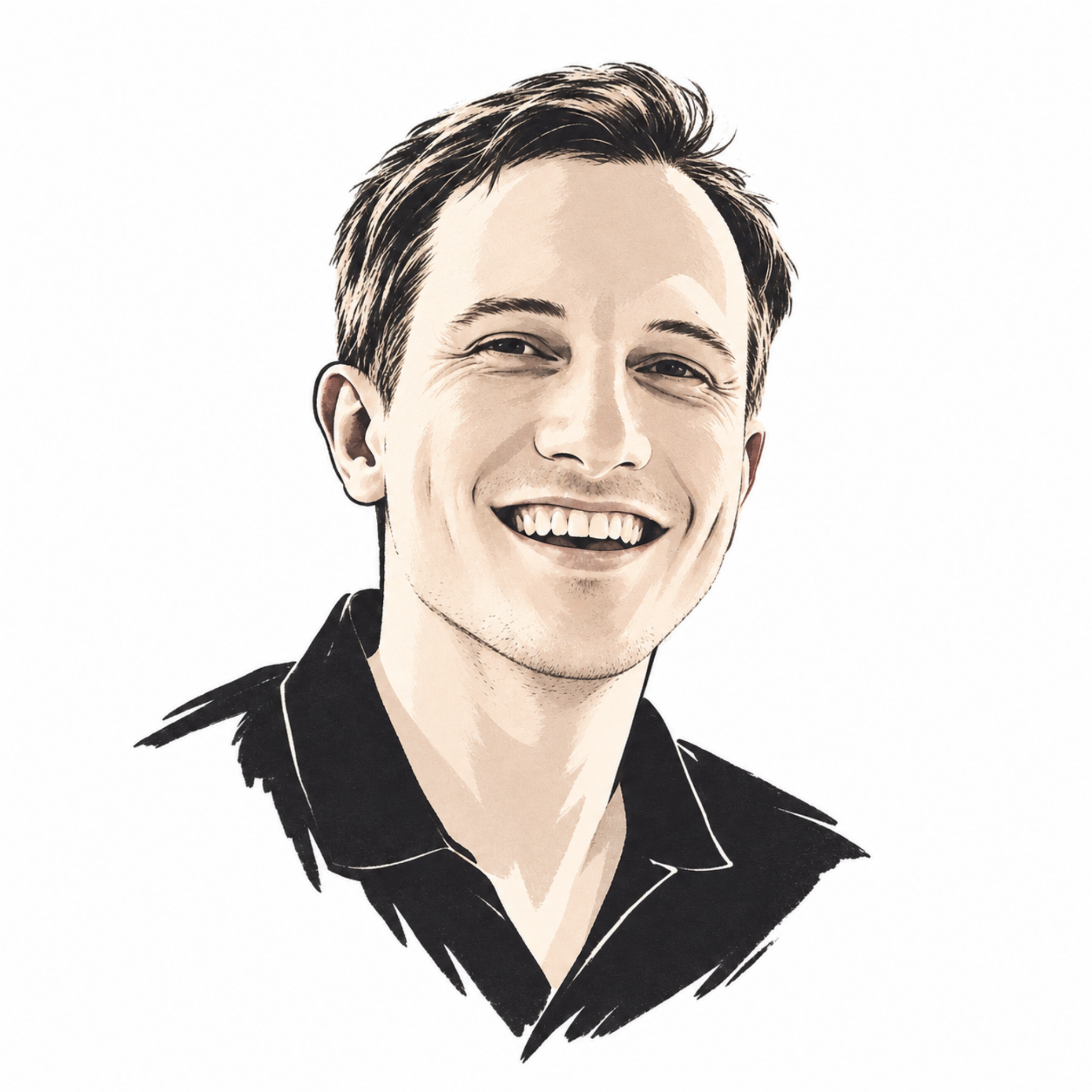
Bio
I’m a cognitive scientist by training, with an interdisciplinary background spanning AI, neuroscience, physics, linguistics, psychology, and philosophy.
I lead AI initiatives for mindline.sg, Singapore’s national digital platform for mental health, at the MOH Office for Healthcare Transformation (MOHT). My work focuses on a portfolio of projects at the intersection of AI and mental health, exploring how technology can help scale and improve our mental health care systems. I’m passionate to explore how AI can support human flourishing, by helping people who are struggling find timely and appropriate support.
I am an adjunct lecturer teaching AI for Healthcare at the National University of Singapore.
I’m also involved with SEACrowd, a non-profit organization working to boost AI performance and inclusion across Southeast Asia. We run a local apprenticeship program to train the next generation of AI researchers and builders. Please reach out if you are based in Southeast Asia and would like to break into AI research.
I sit on a Working Group at Duke-NUS CoRE-SDO to develop and adapt ISO standards for AI in healthcare.
Additionally, I remain affiliated with the University of Cambridge as a Visiting Scientist, where my research focuses on developing algorithms for characterizing brain connectivity from MRI scans and understanding how connectivity is altered in depression.
I also remain active in the research community. I am a reviewer for NeurIPS, ACL, IEEE Transactions on Affective Computing, and Network Neuroscience.
I completed my PhD in the Adaptive Brain Lab at the University of Cambridge’s Department of Psychology, under the supervision of Zoe Kourtzi and Mark van der Wilk. Here, I worked on AI for Brain Science and Mental Health and computational cognitive neuroscience approaches to learning and decision making.
Before my PhD, I helped establish a machine learning team at Goldman Sachs in Hong Kong, bridging the gap between academic research and real-world applications.
During my MPhil, supervised by Pascale Fung, I worked on several projects related to natural language processing and affective computing. Working with Genta Indra Winata, I built a virtual therapist platform that used deep learning to model user emotional states and generate empathetic dialogue-an early preview of my current work at the intersection of AI and mental health.
I received my undergrad degree in Applied Physics from the TU Delft in the Netherlands, where I grew up.