Subjective Knowledge Graphs
Published:
This post describes my view of mental health.
Some years ago I read this blog post by Tim Urban about Neuralink. You should probably go and read it first, he is a great story teller. The main image for this article’s context is the following.

In short, he describes this idea that humanity has evolved to become increasingly intelligent. After we invented language, then writing, and then printing, individuals became increasingly connected with one another. In some ways our “brains” starting being organized into networks. We started outsourcing certain cognitive functions to others, and we could build on ideas of others. This created an exponentially growing body of empirical knowledge and wisdom. The development of the internet has only supercharged this evolution. Companies like Google started building knowledge graphs. A graph is a data structure in which “concepts” are represented as nodes, and the connections between them indicate their relationship.

A slightly bigger graph captures all relationships between characters in Harry Potter.
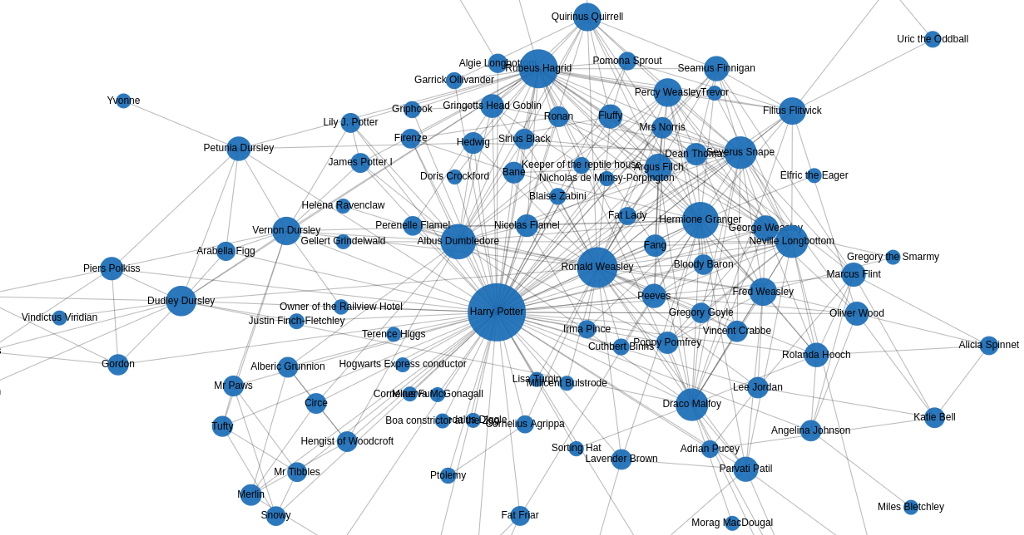
Now, as you can imagine, if you try to build a knowledge graph of all knowledge known to humanity, it will become very big. Unimaginably big. Let’s call this (idealized) knowledge graph the World Knowledge Graph (WKG). We all have some subset of this graph in our head. An American historian might know all the years of Civil War events, a medical doctor knows the Latin names of all organs, a tribesman in the Amazon knows all medicinal properties of plants. But no one has the entire graph in their head, not by a long shot. In some way the world’s graph represents the sum of all knowledge ever held by all humans that ever existed. And being able to represent that into a single machine is what Tim Urban calls the “Colossus”.
But it’s important to realize that these WKGs store consensus and objective knowledge. The connection between Paris and France (that is, “is the capital of”) is the same for every human being in the world. I don’t think anyone would dispute that. But some knowledge is disputed. Religious and non-religious people operate on a different world graph. Scientists disagree on whether certain diets can increase longevity. Some people even believe the Earth is flat, which requires such a tremendous set of auxiliary assumptions and beliefs that their world graph would look very different. But for these cases we can still brush it off as epistemological disagreements: there is still one objectively “true” WKG, and maybe one day we get closer it, but for now we have a level of uncertainty in our beliefs on certain knowledge.
However, some knowledge is fundamentally subjective: there is no connection between certain concepts that are objective (true for everyone). Paris is the capital of France for everyone, but whether Paris is a pleasant place to be differs between people. We all have our own knowledge graph in our head. Some of it is objective, and we can adopt knowledge from the WKG through education in a process we call learning.
How does this relate to mental health? One challenge is to separate out the objective from the subjective. We can take knowledge from the WKG, but we cannot extract subjective connections. No one can tell you whether you should quite your job, because you have a unique set of connections between values and concepts. This is why a therapist will walk you through therapeutic frameworks, restructure and reorganize your thoughts, and inject a lot of wisdom and knowledge into your life. But they will never tell you what to do-this is reserved for the individual.
There are popular note-taking tools such as Obsidian and Logseq that build such personal knowledge graphs.
One elegant way to look at humanity is as a collection of billions of such graphs, living in a shared reality with a shared WKG. No matter how powerful AI becomes, it will still only represent the WKG. True personalized AI has to be aware of both the world graph and the personal, subjective graph.
Further Reading
- Neuralink and the Brain’s Magical Future. Tim Urban.